
The importance of Self-care
What is Self-care?
For many people, when they hear the word “self-care” they think it has to be something extravagant and needs to be done for a long period of time. However, the term self-care is simply the act of giving attention to our own physical and psychological health. This is so that you can preserve, protect and improve your own well-being. In other words, self-care refuels us and does not take away from us. These acts can be something small that is done daily that helps us feel refuelled. It doesn’t have to be anything big or excessive!
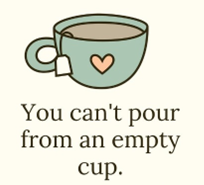
After all, we often hear it said: You can’t pour from an empty cup!
 Why do we need Self-care?
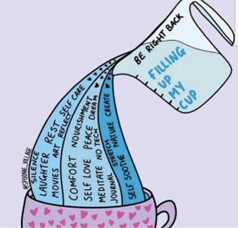
Self-care reduces the impact of stress and the potential for burnout whilst also assisting in improving motivation, emotions and the state of professional and interpersonal relationships. Self-care ultimately helps us to re-fill our cup so that we can attend to our daily lives and pour from it. Self-care includes our holistic well-being such as your physical, mental, social, emotional and spiritual well-being. It is important to take care of ALL of your well-being domains!
Examples of Self-care
Physical self-care
 Taking care of your body helps it to run more effectively. Remember, there is a strong connection between your body and mind. This means when you take care of your body, you will think and feel better too. Physical self-care consists of activities that help us stay healthy and fit. Examples include maintaining a good sleep schedule, eating enough throughout the day and ensuring our food fuels our body and maintaining personal hygiene like brushing teeth, showering, washing hair etc. Exercising, even mild exercise such as a walking or yoga is good, being in nature and knowing your personal signs of stress.
Social self-care
 Social connection is important for your well-being. Activities that involve connecting and interacting with people who are important to you. Having caring and supportive people around you builds a sense of belonging and connectedness. Connecting with family, friends or a mental health care-worker via telephone, text or platforms such as Zoom or Skype are vital. It is important to also limit the amount of social media one takes in daily.
Mental self-care
 The way you think and what you think influences your psychological well-being. Mental self-care includes activities that help you stay mentally healthy and stimulate your brain.
Examples include taking an online course, reading, building a puzzle, crosswords or sudoku, learning about a topic that interests you and practicing self-compassion and acceptance.
Emotional self-care
 A healthy body starts with a healthy mind. It is important to have healthy coping skills to help you deal with uncomfortable emotions. Emotional self-care may include activities that help you become aware of your thoughts, feelings and emotions on a regular basis. A psychologist or psycho-therapist can assist with identifying and processing emotions appropriately.
Examples of emotional self-care include – individual therapy sessions, painting, drawing, writing poetry, journaling, listening to music, creating music, cooking or baking, knitting and clay work. Practicing gratitude, kindness and positive self-talk are also important.
Spiritual self-care
 Spiritual self-care can include religion, spirituality, meditation or anything that helps you develop a deeper sense of meaning and connection with a higher self or being.
Think about what helps you to feel at peace and have hope.
Examples include – being in nature, praying, attending a religious sermon, sitting in the sunshine, deep breathing, meditation and keeping a gratitude journal.
Self-care during illness, isolation or a pandemic
 The ability to care for yourself and about yourself alters during times of stress and change. The pandemic, for eg., shifted priorities and motivations. This may make us feel that caring for ourselves is selfish. The changes in self-care with other added issues can result in personal difficulties. During these difficult times, having empathy and compassion for yourself and for others is essential.
Self-care tips whilst working from home
Designate a workspace
Set up a clutter-free area of your house to use as a workspace. Sitting down in this space sends a clear signal to your brain that it is time to focus. Stay away from your designated workspace when you are not working! This is to separate the professional from the personal side.
Move around
Try to limit the amount of time you remain seated, by either getting up every 30 minutes to an hour, walking around the house a few times or going outside to get some fresh air. Creating a mobile workspace may help your posture since you will be changing your seated position. Make sure that your workspace is ergonomic to remove risk factors that lead to musculoskeletal injuries and allow for increased performance and productivity.
Create a schedule
Create a daily schedule that works for you and put it in writing. Once the schedule is created, put it in a visible place. Come up with a detailed to do list that is broken down into categories based on importance. Having a plan for each day or week is an effective way to ensure that you stay on track. Remember to be gentle with yourself and listen to your body. This means that you do what you can do, within the period that you have.
Some simple Exercises
“Just one breath” breathing activity
Find a relaxing place, sit comfortably and set a timer for one minute. Breathe deeply in and out while paying attention to any sensation you notice or sounds you hear. Take another slow deep breath, imagine the air moving down into the lungs and back up. Take one more deep breath and hold for a moment, then release it.
 Forest bathing
Forest bathing is a Japanese practice of “Shinrin-yoku” which simply means walking in an area with trees and inhaling the fresh air. Trees release certain chemicals that activate our parasympathetic nervous system, which help us to relax and de-stress.
Grounding with your senses
Name five things you can see, four things you can feel, three things you can hear, two things you can smell and one thing you can taste.
Practice mindfulness
The Safari exercise is an amazing way to help kids learn mindfulness. This activity turns an average, everyday walk into an exciting new adventure.
Tell your kids that you will be going on a safari! Their goal is to notice as many birds, bugs, creepy-crawlies and any other animals as they can. Anything that walks, crawls, swims or flies is of interest and they will need to focus all of their senses to find them.
A similar exercise for adults is the mindfulness walk. This exercise provokes the same response in children that a mindful walk elicits in adults – a state of awareness and grounding in the present.
How can The Goddess Factor® help to relax, uplift and empower you?
Virtually all the treatments at our Clinic are pampering sessions with the desired skin rejuvenation & body sculpting results you want and expect! So come and be treated in heavenly privacy!
People sometimes fall asleep during Dermaplaning, even though it’s performed with a blade. Here our highly skilled Somatologists, not only removes the top dead layer of skin, but also the peach fuzz or vellus hair; those tiny little hairs all over your face.
Rejuvenating your hands up to your elbows with a Microdermabrasion treatment to remove crepey dry skin and pigmentation, followed by a rejuvenating massage, will leave you utterly content!
For body relaxation we have various Massages to choose from, like Hawaiian Lomi Lomi, Indian Head, Hot stone, Aromatherapy, Swedish and the ultimate is using our Radio Frequency Massage Head which is warm and relaxing and gets into those tense, tight muscles!
There is also Reflexology – which is almost medicinal – as it stimulates various points of dis-ease in the body by massaging the corresponding areas on the feet.
If you want to prepare your body for Summer and get rid of that dreadful Cellulite, we have solutions!
A Lymphatic massage with Lilian Terry Oils gets the lymph flowing, coupled with Cupping – this is using a flexible cup to stimulate blood flow – and then either finishing off with Radio Frequency to firm and tighten that skin or applying CELLU-Wrap Cream and then wrapping the area in Salon-wrap to enhance the outcome.
To further reduce Cellulite and Fat Pockets, a few sessions in our Presso-Therapy suit will stimulate lymph drainage and detox your system.
To give yourself the ultimate lift and negate thoughts of feeling fat and unattractive, get rid of those unwanted fat pockets now! Come for 3 Cooltech® Fat Freeze sessions – 1 every 4 weeks – and we give you a pampering foot or hand massage, whilst you wait for the fat cells to be eliminated through the Lymphatic system.
It’s only a little uncomfortable the first 5 minutes, then the fat pockets are frozen and you have no sensation in the treated areas. You can dose off or do some work on your laptop!
One should not neglect your mind, skin, body & soul ever!
 Reflection
- What have you experienced personally in the last little while, that you have enjoyed doing?
- Despite there being some negative feelings, what have you personally done that has helped you to recover from that negative state?
- How have you managed to keep focus on what is really important?
- What have you done that is special either for yourself or for someone else?
Where can one get help?
- Please contact SADAG – South African Anxiety and Depression Group @ 011 234 4837 or 24 hour Helpline @ 080 045 6789
- Lifeline @ 011 728 1331
Ms Bernita Soares
Educational Psychologist at the Family Therapy Centre
Contact on (011) 432 2056 or 062 998 2625
admin@familytherapycentre.co.za
Reference: https://www.verywellmind.com/self-care-strategies-overall-stress-reduction-3144729
Recent Comments